bigthinkeditor

“The financial crisis in America isn’t over,” says James Galbraith. The renowned economist explains how restoring the rule of law on Wall Street should be the nation’s top priority.
Microsoft’s Imagine Cup challenges high school and college students to develop apps that address the world’s most pressing problems. The result is humanitarian mobile devices.
The online cartographic authority, Google Maps has the unenviable task of drawing borders across the most hotly contested territories on earth. Sometimes the company riles border disputes.
“Higher marginal tax rates mean more resources for job-creating, wage-generating public investments.” Slate.com says liberals agree: higher tax rates are a step away from debt.
“Plato imagined philosopher-kings guarding his utopia. Here in Aspen, we have Bill Gates.” The Atlantic says Gates’ unique solutions to global problems were on display at the Aspen Ideas Festival.

Violinist and humanitarian Midori Goto stopped by the Big Think offices today. She played show and tell with her priceless violin, made in 1734, which she said she thinks of […]
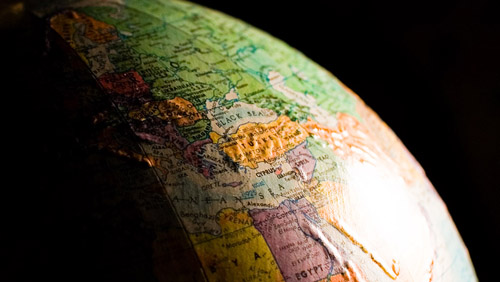
It’s a bit of an overstatement to say that Americans don’t care at all about what’s happening outside of our borders, but Jim Hoge, the longtime editor of Foreign Affairs […]

In the history of the Universe, life—and human life in particular—has not been around for very long. But University of Michigan theoretical astrophysicist Katie Freese believes it’s possible that life […]

The Jewish community in Britain represents only one-half of one percent of the population, but Lord Rabbi Jonathan Sacks believes it need not have a commensurate voice in the “human […]
“The spread of digital technology comes at a cost: it exposes armies and societies to digital attack,” says The Economist, which thinks cyberspace must be treated as a theater of war.
Spiegel follows the “Elvis of cultural studies” to a conference in Berlin where he presents his esoteric and eccentric ideas on the behavior of “late capitalism”.
Two independent reports have exonerated the “Climategate” scientists, but you wouldn’t know it to read the news. Salon.com takes on the wet-noodle, mainstream press.
“An aircraft fueled by the sun has accomplished its first ever manned night flight,” reports the New Scientist. The Swiss aircraft broke several records for a piloted solar flight.
“We’ve plenty to protest about in the US, but on the streets there is no dissent. Why is our liberal mood so paralytic?” Clancy Sigel blames a host of culprits, including the Internet.
Government scientists have found natural HIV antibodies necessary for an AIDS vaccine, reports Scientific American, but stimulating their production in the body remains a hurdle.
“How does a defunct and discredited diplomatic process continue to masquerade as a success despite its utter failures?” An Al Jazeera analyst writes about the Middle East “peace process”.
“By the end of next year, there’s a good chance that Android devices will have displaced the iPhone in terms of sales.” The Independent predicts closed-source programming will end Apple.
“The Gulf oil spill ranks as the nation’s worst environmental disaster only if you ignore the great ongoing spill in the sky.” The L.A. Times says air pollution gets a pass, but shouldn’t.
Thinking of launching its own social network site, Google has criticized Facebook’s “friend” function because it creates networks that don’t respect the boundaries of real life.

Is Comedy Central’s “The Daily Show” sexist, as a recent post from Jezebel’s Irin Carmon suggests? A collection of female staffers from the program have publicly disagreed, and Slate’s Emily […]

What should the U.S. do about the 26 million people who are currently unemployed, underemployed or marginally attached in the labor force? Boston College sociology professor Juliet Schor thinks that […]

With so much information being stored in Web databases around the world, data now created will potentially stay recorded in the memory cloud forever. That’s why Viktor Mayer-Schönberger, Director of […]
Dual use technologies make it especially difficult for countries to negotiate agreements over the weaponization of space. The New Scientists asks what positive steps can be taken.
“Hypocrisy is always a double edged sword; but in the case of anti-colonial struggles both sides of the blade cut the weaker party more deeply,” says history professor Mark LeVine.
A little financial education can be a dangerous thing, says one MIT professor of management. It gives investors a false sense of confidence in a world where complexity rules.
The online game Blizzard now makes its users submit their real first and last names in order to post comments. True/Slant asks if this is the end of Internet anonymity.
“We all know that real men don’t eat quiche,” says Miller McCune. “New research suggests men opt for foods associated with a masculine identity — even if it means passing up something they prefer”
We often treat our future selves they way we would treat others, preferring to help later than sooner, says Scientific American. Think of your future self and you’ll save more money.
“Scientists have questioned the assumption that a lack of exercise causes fatness in children.
The study suggests that physical inactivity appears to be the result of fatness, instead of its cause.”