bigthinkeditor


Nobel Laureate Bill Phillips stopped by Big Think today to talk about his work in laser cooling, which won him the Nobel Prize in 1997 and is the reason that […]

When it comes to business sustainability, do we need top-down or bottom-up approaches? Erik Rasmussen, CEO of the think tank Monday Morning and founder of the Copenhagen Climate Council, believes […]

Geoff Jones, a Harvard Business School professor, knows everything there is to know about mascara. He’s an expert on the beauty industry, a sector that dates back to ancient civilization. […]

We live in an intriguing era of self-disclosure. Tonight, in New York City, the World Science Festival features a panel discussion called Strangers in the Mirror: “What’s it like to […]
“Intuition can help us make good decisions without expending the time and effort needed to calculate the optimal decision, but shortcuts sometimes lead to dead ends,” says The Chronicle of Higher Education.
The L.A. Times comes out swinging against baseball’s “halfhearted embrace of technology”. The Galarraga case sparks new calls for technology to double-check humans.
One of the world’s foremost art collectors, Charles Saatchi famously refuses to be interviewed, but here he answers some questions put to him via email by The Daily Beast.
Movie violence against women has long been a staple of mainstream film-making but is becoming ever more forensically detailed, claims a troubled Natasha Walter.
Michael J. Formica says taking personal responsibility is essential in overcoming addiction but systems like AA allow its abdication.
Corruption slang can sound cute in foreign tongues. Euphemisms may belittle cross-border bribes but they are still illegal, warn James G. Tillen and Sonia M. Delmans.
Cleopatra is the selling point but the resurrection of a long-lost world is the strength of a powerful new exhibition at the Franklin Institute in Philadelphia.
As India wrestles with the politically-sensitive question of including caste in its 2011 census, P. Sainath looks at a once strong anti-caste reform movement.
What should happen to the former Stasi HQ? How much of a glimpse into history, and whose interpretation of it, should it offer?

Astronomer Jill Tarter, director of the SETI Institute, stopped by Big Think today to talk about the question she’s spent her career trying to answer: Is there intelligent life on […]

When designer Katie Salen was teaching at the University of Texas a decade ago, she came upon a novel teaching method while trying to help her students understand online interfaces […]

Juliet Schor, a professor of sociology at Boston College, came in yesterday to talk about the new business as usual. What’s going to bring us out of the current recession? […]
The New Yorker looks at how American intellectuals are reacting to Ayaan Hirsi Ali and Tariq Ramadan, two authors born into Islam who now support the liberal-democratic project.
Labs in England are developing machines that can essentially replicate themselves by building their own spare parts as an insurance against future mishaps, reports the New Scientist.
In the wake of the British Petroleum spill in the Gulf, who dares to defend conservative free-market principles decrying regulation? Nobody can afford to, writes The Wall Street Journal.
“An increasing number of Jewish activists in Europe and the U.S. are expressing their displeasure—and even anger—over the way in which Israel has evolved in recent years,” says Al Jazeera.
“I always said I wasn’t going to write about Norman because no one would believe it,” Norris Church Mailer once said, but now she has written a memoir about her marriage to the novelist.
“Are we more or less likely to lie to someone if we are communicating via email or text message than if we are speaking face-to-face?” asks Professor Jeff Hancock of Cornell University.
The digital divide is about more than access to the Internet, say experts. The white Anglo-Europeans who program the Web may set culturally exclusive parameters on the experience.
Garrison Keillor is feeling especially powerless these days: “As the Gulf turns dark and the polar ice cap melts, I intend to listen to Bach more and listen to the news less,” he says.
“For the first time, physicists have confirmed that certain subatomic particles have mass,” writes the L.A. Times. The mass could account for the mysterious existence of dark matter.
“Do people really die of broken hearts?” asks the Times’ health blog. Elevated stress hormones following an emotionally trying event may cause cardiomyopathy, a.k.a. broken heart syndrome.

Exactly one decade ago, on June 2, 2000, President Bill Clinton proclaimed June to be Gay and Lesbian Pride Month in the United States. Last year, President Obama updated the […]

Because of the climate crisis created by wealthy countries, developing countries could be pushed to slow their development. Would that be fair? Charles Ebinger, Director of the Energy Security Initiative […]
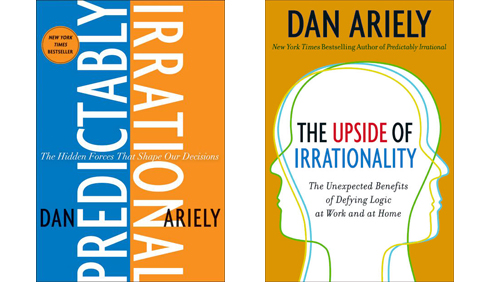
Dan Ariely, the author of “Predictably Irrational ” and “The Upside of Irrationality ” stopped by Big Think’s offices yesterday to talk a little about the findings in his new […]

How did writer, actor, and filmmaker John Cameron Mitchell come out? “I think I told a woman who was on top of me,” he jokes in his segment of Big […]