bigthinkeditor

When a journalist mistakenly wore shorts to visit Guantanamo Bay, he was refused entry into the prison. Instead, he was taken to the library where the prisoners’ art was hung on display.
As California prepares to vote on a ballot initiative essentially legalizing marijuana, The Atlantic looks at the pop music—from Louis Armstrong to Ben Harper—that found peace with the drug.
“The former English prime minister Tony Blair argues the West has become too imbued with doubt and lacking in mission.” Blair’s new memoir speaks on restoring purpose to government.
“Is human uniqueness really nothing more than a neurological phenomenon?” A philosopher and author calls neurology’s entry into the human sciences the emergence of ‘neurotrash’.
“Like Southern Europe, the US economy must move away from the consumption/housing-led growth model of the last decade.” Can stimulus facilitate a structural change in the economy?
“The Internet has been a great unifier of people, companies and online networks. Powerful forces are threatening to balkanise it.” The Economist on the future of the Internet.
The Simple Dollar blog reviews nine ways to accomplish more by working smarter, not harder. Conquering technology and building stronger relationships are two recommendations.
“Culinary Luddism has come to involve more than just taste; it has also presented itself as a moral and political crusade—and it is here that I begin to back off,” says one historian.
After a recent paper showed that immigrants do not steal jobs from Americans, economic pundits are highlighting other ways immigration benefits the national economy.
Nicholas Rombas at n+1 reviews films as an homage to French surrealists André Breton and Paul Éluard by walking into theatres randomly and leaving as soon as the plot makes sense.
“Colombia is no longer the most dangerous country in the Americas.” Government grants for would-be drug farmers and an increased provincial presence have stabilized many areas.
While diets often prescribe eating right or eating less, The Economist says dieters seek out excuses to cheat. In situations where non-dieters would be content, dieters continue to eat.
To what extent do we treat computers like humans? If computers praised our abilities, told us we were doing a good job, would it flatter us or would we see through the artificial compliments?
“People are more likely to acquire new health practices while living in networks with dense clusters of connections—that is, when in close contact with people they already know well.”
“Policies that generate more widely shared prosperity lead to stronger and more sustainable economic growth—and that’s good for everyone.” Robert Reich on how to fix the recession.
“TV shows are emerging as a new front in the war over digital media between Amazon.com Inc. and Apple Inc., amid their ongoing battles over electronic books and online music.”
“The universe arises from scientific processes, not God—as Hawking himself would have agreed decades ago.” Hawking hasn’t changed his mind about God, says a former interviewer.
The prosecution of Roger Clemens for perjury is wasteful and hypocritical, says Steve Chapman at The Chicago Tribune. The Justice Department should have higher priorities.
“The U.S. military’s Central Command has proposed pumping as much as $1.2 billion over five years into building up Yemen’s security forces, a major investment in a shaky government.”
“Here’s the central paradox of American jobs and education. While benefits from going to college are increasing exponentially, the fastest growing jobs aren’t for high-earning college graduates.”
“By reshaping our minds, the internet is robbing us of the ability to think critically and creatively, says the author of The Shallows, Nicholas Carr.” The New Scientists conducts an interview.
“Is it possible to reach peace in the Middle East? Israelis, Palestinians and negotiators from around the world—and the United States, in particular—are making another go at it.”
“The contemporary customer is mad as hell—fed up with inept service, indifferent employees, and customer-service departments that are harder to negotiate than Kafka’s Castle.”
“Apple has unveiled a new music social network that could rival Facebook and Twitter, as well as an Apple TV that can stream movies and television shows directly from the Internet.”
A new book tells the story of how a Parisian perfume magnate persuaded Proust’s family not to destroy his effects, among which were his manuscripts and famous overcoat.
“A small fleet of privately developed spacecraft will head into orbit in the next few years.” Technology Review looks at which companies are most eager to explore the final frontier.
“The universe was not created by God, scientist Stephen Hawking has said in his new book. Professor Hawking believes the laws of physics were behind the Big Bang instead.”
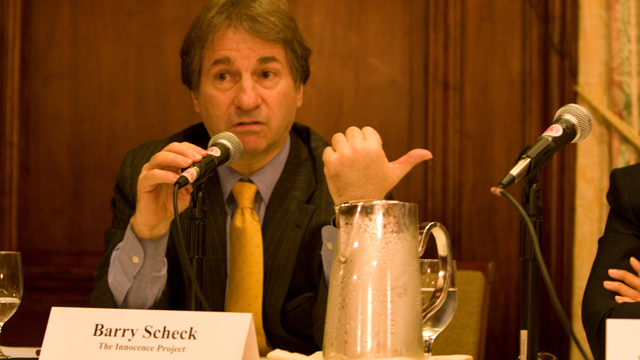
Everyone in jail claims to be innocent, but attorney and law professor Barry Scheck has proven that many of these convicted criminals may actually be telling the truth. Scheck is […]
“Apple is expected to use its press conference later today to unveil new-look iPods, a revamped Apple TV and possibly a music-streaming service, according to industry observers.”
“People who drink heavily live longer than those who completely abstain from alcohol, according to a new study conducted by a psychologist at the University of Texas.”